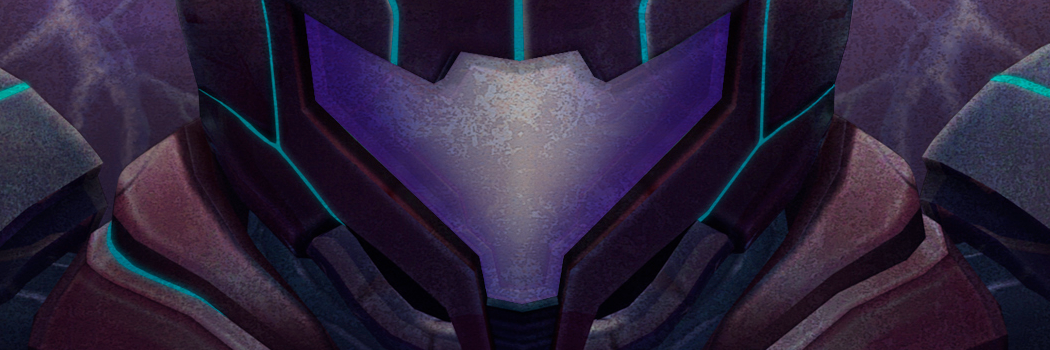
This review is written for all versions of the Metroid Prime trilogy.
Sometimes I worry that the games I love won’t be remembered in the future. Maybe it’s bizarre of me to think of the things I’ve played in the last few years to be “classics”, but at the same time certain games make certain impressions that are going to stay with you for as long as you are a player. And for every Super Mario Bros. or Ocarina of Time that is classified as “one of the greatest games of all time”, there’s a Lode Runner or River Raid that is highly regarded by older gamers but hasn’t been played or heard of by the newer generation. That’s part of the reason I started writing these reviews; some of my favorite games seem to have come and gone in such a way that I wouldn’t be surprised if gamers ten years from now haven’t ever heard of them. One example of this is a series that has received extremely positive press after it was debuted in 2002, but seems to have completely disappeared since the trilogy was completed. I’m talking about Metroid Prime.
I’ll break down the gameplay of this series first, seeing as how it is largely unchanged game-to-game. Prime effectively takes the old school exploration and adventure formula of the earlier games in the franchise and converts it into a 3D first-person game. The core of the NES and SNES games is here, but expertly upscaled to modern standards. You’ll explore an expansive world that spans several different environments while obtaining plenty of new items that unlock either new environments or secret areas in ones you’ve already traversed. The shooting is governed by the lock on system, which may sound overly simplified, but in reality grants a level of control to battle that can take place of large distances or in close-combat with multiple enemies. The upgraded beam weapons are also here, with Ice, Wave, Plasma and others all being fully represented (although the ability to switch between them at will adds some extra dynamicity to the shooting). You also have access to the Morph Ball, which usually switches the game into an either top-down or side-scrolling puzzle/platformer that requires a good bit of timing and finesse to get to the goal. Finally, the one thing that Prime really adds to the exploration formula are visors. These range from things like the Thermal visor that lets you see enemy weak points and follow electrical circuits to the X-Ray visor that makes certain targets and platforms visible. The real draw to the visors is, however, the scan visor, which lets you scan just about every single object in the world to get more info. This ranges from environmental targets like destroyed walls or ruins to scanning enemies for improved targeting data and scanning computers and ancient relics for backstory into the world that you are exploring.
 |
| Ridley really is unkillable |
I’ll be frank with you: while the entire Prime trilogy is quite good, the main reason that it sticks out to me as a modern classic is because of the original game. Simply put, it’s the best. I starts out with Samus Aran, intergalactic bounty hunter extraordinaire chasing down some evil Space Pirates (because honestly, is there such thing as a good Space Pirate) to their space station above Tallon IV, a desolate planet near to Zebes, where Metroid and Super Metroid take place. In typical action-adventure fashion, everything aboard the station is crapped up and Samus end up losing her advanced weaponry and is sent to Tallon’s surface to figure out the reason for the Pirate’s fascination with the planet. What she finds is that the planet is afflicted with Phazon, a material similar to the Tiberium of the C&C franchise that landed on the planet decades before and has infected much of the wildlife. The Pirates, being evil as they are, are attempting to harvest the Phazon for evil purposes and Samus is required to traverse the planet to recover her lost gear and fight her way through numerous, extremely complex locales to locate the Pirate base and wipe it out.
One of the reasons Metroid Prime stands out so much is because of the variety it presents to the player. While the core systems remain largely unchanged, the game smartly amps up Samus’s abilities in such a way that it stays completely manageable despite double jumps, four different beam weapons, five different missile weapons, two Morph Ball bomb attacks, boost modules, gravity suits and more. Every area, be it the rainy jungle or the desert ruins or the ice and lava worlds not only feels different, but has different enemies that require different attacks to beat. On top of that, just moving around the environments is a blast because on top of the extremely controllable running and jumping you have things like Morph Ball half-pipes and grappling points that are always fun to zip around in. Finally, I need to give a specific shout-out to the boss battles. This is a game that came out years before Shadow of the Colossus, and an FPS to boot, yet it still manages to pack some of the biggest enemies every seen in gaming onto the screen. Among these are the early-game Flaahgra, and praying mantis looking boss that you need to burn out with sunlight, and the late-game Omega Pirate, an eighty-foot behemoth that is simultaneously one of the hardest and most satisfying battles of the game.
I also need to express my admiration of Prime’s atmosphere, which is unmatched by anything before or since. There is an overwhelming sense of loneliness in the game, and I don’t mean that in a depressing way. It’s simply a fact that you are alone on this planet. There are no allys, no whitty sidekicks. It’s just Samus trudging along, trying to survive and thrive on this extremely hostile world. Hell, if you turn off the hint system there isn’t even any indication of what the objective is, which is absolutely how I recommend you play the game. Even the way that rain hits your visor and you can see Samus’s face in her visor if you’re nearby a large enough explosion just show how isolated you are Tallon IV. The music also contributes to this, ranging from eerie, ambient sounds in the ruins to a light, sad bit of piano in the snow area to the deep, menacing bass in the lava. It sounds great, and that’s boosted by the fact that there is literally no voice acting whatsoever makes it even better. That’s not to say that it’s a Zelda-style system where you have subtitles but no audio. There’s just no dialogue, nor any reason for anyone to talk. Samus will grunt if she’s shot or falls a long way, and enemies will roar or snarl at you, but that’s it, and it makes Prime that much more riveting to play through.
 |
| Boss battles in Dark Aether: Not a fan |
Now it’s time to move on to Metroid Prime 2: Echoes, which is sort of a bummer. Make no mistake, Echoes is in no way bad, and in many ways it is as good as the original Prime, but that’s just because a huge percentage of the game is effectively the same. This time Samus is investigating a distress call from another unexplored planet, this time Aether. Upon arriving, she finds out that another Phazon meteor had broken the planet into two separate dimensions, light and dark. While the light side is just the regular planet, full and angry wildlife, the dark side is covered in a damaging dark aura and is full of Ing, an evil race that is trying to take over and merge the two sides of Aether. The Ing are also being run by Dark Samus, an entity created by the events the occurred on Tallon IV. After falling into the dark side of Aether, Samus has the crap beat out of her by Dark Samus and retreats back to the light world, losing all her gear. Now she needs to reequip herself and help a friendly race called the Luminoths fight the Ing and destroy Dark Aether for good.
A few of my issues with Echoes should be apparent. First off, the format of the game is largely the same as Prime, with Samus losing everything and having to start from scratch again. Sure, it’s a staple of the genre, but the way it happens identically to before is kind of lame. Also, the world of Aether just isn’t as interesting. Instead of fire and ice and jungles and underwater spaceships and all the crazy variety of Prime, Echoes has you traverse environments like “arid wasteland” and “swamp” and “horribly-detailed tech city”. On top of that, the game doubles up on environments because you travel through both the light and dark versions of them. And sure, there are minor differences and new enemies between the two, but really it’s just a darker re-skin of the same places you’ve been, except you take damage when outside of certain safe-zones. Finally, the tone of the first game is gone. While the idea of exploring this messed up, dark world seems perfectly in line with the isolation of Prime, the fact that your Luminoth friend has all sorts of vaguely-philosophical things to say is annoying, and the fact that he straight up tells you “Hey, go here and turn off this giant generator to save Light Aether!” completely breaks the immersion. If you really like Prime, then Echoes is more of the same, except a tiny bit worse. That’s by no means a bad thing, it’s just a little disappointing that rather than innovating even more on their concept, they sort of drove it into the ground.
 |
| Each world in Corruption look completely different |
Prime 3: Corruption is weird. It’s also a better game than Echoes. But God, is it weird. The game starts off by completely throwing out all semblance of atmosphere set up by the first two games by putting Samus into the middle of a gigantic war between the Galactic Federation and the Space Pirates, who continue to be extremely evil. While Samus remains completely silent, you get a boatload of voiced dialogue from admirals and computers and your fellow bounty hunters, who are literally some of the worst characters ever to be in a game. Seriously, all the other bounty hunters are selfish, cocky and generic characters who I’m guessing I’m supposed to find cool and edgy, but just make me want to murder their digital selves. As it turns out, the Space Pirates decide to team up with Dark Samus, who survived the events of Echoes and is now trying to spread Phazon across the galaxy by smashing gigantic Leviathans into targeted planets with the intent of slowly corrupting them to be absorbed by Phaaze, the source of the attacks. This means that Samus is deployed to three different planets in order to destroy the implanted Leviathans and to track down Phaaze to stop Dark Samus once and for all. Samus and her shitty friends are also infected early on by her doppelganger, which of course causes you to lose some of your weapons but also grants you use of Hypermode, the ability to sacrifice health to completely obliterate everything in your way and is pretty fun to use. It’s also fortunate because it turns the other bounty hunters evil and lets you kill them over the course of the game, which is satisfying evil if the battles themselves are not.
These worlds are where the vast majority of the game takes place, although again the environments aren’t the most interesting ranging from everyone’s favorite “arid wasteland” to “steampunk sky city” to “industrialized Pirate homeworld”. They aren’t the most exciting levels ever put to game console, but they are still worlds above those from Echoes. I do need to point out two more environments, however. The first of these is the GFS Valhalla, a derelict ship that you get more and more access to as you earn more weapons and abilities throughout the game. It is such a warped bit of space scrap full of weird enemies that it’s fascinating to explore and scan everything you can see just because of how eerie and quiet the atmosphere is. Also worth mentioning is Phaaze, which is encountered very late in the game and is, like the Valhalla, a twisted and bizarre world but in a completely different way. Finally, I want to give a shout to the final boss, which manages to take something from the pre-Prime games in the franchise and make it fit extremely well into the tone and plot of these games.
So there you have it: my thoughts on the Prime series. In reality, the first Prime is the only one that I would consider a modern classic. Echoes is fun but is mostly just a less interesting rehash of the same material. Corruption is bizarre and strays significantly from what makes the first game work, but in the process made a fascinating and complex world that is impressive on any system, let alone the Wii. If you haven’t played any of these games and just want to see the best, pick up the Gamecube version of Metroid Prime, which you can get for a couple bucks at this point. However, if you’re fully interested by what I’ve had to say, you should absolutely spring for the newer Metroid Prime Trilogy, a compilation for the Wii with updated graphics and controls for the first two games (for the record, I’d be the first person the bitch about horrible Wii controls, but the fact is that the Wii versions of Prime and Echoes play better than the originals). The problem is that Trilogy is relatively rare and has actually gone up in price since its release. It may sound ridiculous to pay $70+ for multiple older games, but I cannot stress enough that they all hold up extremely well, and each with give you 20+ hours of gameplay. You could probably buy all three games separately for significantly cheaper, but Trilogy is well integrated and does so well by all three games that I would wholeheartedly recommend you cough up the extra cash if you can afford it. Still, no matter how you do it, Prime is a game that demands to be played. You need to get your hands on it at some point, lest it disappear into the void of great games that no one remembers in the years to come.
Images courtesy of Google.com
Images courtesy of Google.com


 . It is without a doubt the highpoint of the series, and has such a tight focus that every aspect is forced to be as well-constructed as it possibly could be. After that, the proposition is dicier. The
  is probably the better of the two remaining entries, but if you can only get one of them it makes more sense to get
  . Getting both Gamecube entries gives you the same controls and the same system, and the fact that they follow largely the same story makes them excellent companion pieces (not to mention that Rebel Strike contains co-op for its predecessor).